24 May 2026

On birding as an activity, with goals and consolation prizes

There's been a regionally rare bird present on my "home patch" for over a week now, one which I hadn't seen or photographed before, and this left me determined in a rather possessive way to find it. I hadn't focused on the relevant eBird notifications, but my interest was piqued when I saw a report of a group's sighting. I went to the site that afternoon following some directions that I later realized were ambiguous and could refer to two different places. Naturally, I perched myself at the wrong one, but a helpful birder saw me sitting there, duly equipped with camera and binoculars, and asked if I was looking for the rarity. She told me that I was at the wrong place, and we walked together for a few minutes to reach the right one. Once we arrived, we spent a while while calls were being heard, but didn't see the bird. It's very helpful to have more than one set of eyes and ears looking, especially when the ears (like my own) aren't fully capable. 

I went again the next day, and found that there weren't as many other people around. Armed with the amazing Merlin app (real-time spectrum analysis in your pocket!), it was clear that many birds were about, and that the rare one was among them. I did see it briefly as it flew from one tree to another, but couldn't get photos. I did get a couple of other nice views as consolation prizes, though, of a Common Yellowthroat and a Willow Flycatcher.

Having invested two outings without succeeding in my goal, and having one more day available before a rainy forecast, I went again for a third try. Thanks to another helpful birder for helping me to find my first-ever Prothonotary Warbler!
Among birders, a "life bird" (a species that one observes for the first time) is generally considered as an accomplishment, and something for which one should be congratulated. Different people choose to interpret "observed" in different ways. Some consider hearing a recognized call as sufficient, others count only visual sightings, and some (like me) only consider a bird as truly observed when it's photographed. Whatever the metric, the desire to add to the counted list seems to be universal. Happily, most birders are friendly and cooperative rather than being competitive in a hostile way. When one or more birders are trying to find a challenging sighting, someone else can walk up and instantly become part of their group. That's nice.

03 December 2023

Different premises, different conclusions

As will be apparent to anyone reading this blog, bird photography is a Thing for me. This is an activity ordinarily pursued with a long lens; my usual setup totals about 5 pounds, or another half pound if I add a teleconverter. I'm used to toting it, but it does get heavy after a while, and I might not want to pack it if I were going on a trip that wasn't targeted at birding. So, I was interested in finding a possible alternate optic that might be usable even if not quite as good. I was intrigued to find that I could buy a used Canon 70-300 DO lens in excellent condition for less than $350 USD. This lens is notably shorter than others in its focal length range, thanks to its use of Diffractive Optics (DO) technology. It was expensive when it was introduced in 2004, and opinions about its sharpness and contrast for an expensive lens have been mixed

In 2004, digital camera technology wasn't nearly as advanced as it was today. A 6 or 8 megapixel sensor was competitive in consumer-grade DSLRs, which limited the number of pixels that could be cropped away to frame a small subject without visibly diminishing resolution. Sensors were also less capable of operating at high ISOs without becoming excessively noisy. Since bird photography often requires fast shutter speeds, high ISO usage is often necessary.

Today's sensors are much larger and can reach into higher ISO territory before becoming intolerably noisy. Digital post-processing technology provides impressive denoising capability, and AI software products like Topaz Photo AI can often extract or reconstruct image detail that's otherwise lost to the naked eye. One relies on the AI to derive and reflect detail that's actually present in the scene being photographed rather than hallucinating artifacts that aren't, but that's a larger question that I won't attempt to reconcile here. Rather than considering the output from a camera as necessarily comprising an end result in itself, it can now be provided as the input to constructive post-processing. The test of a camera and lens combination, therefore, need not be the appearance of the photos that it outputs directly, but rather whether the information contained in them (most likely, in their RAW files) is sufficient and suitable as a basis to create even better results digitally.

When I looked at a trial image taken with the DO lens (significantly cropped, as most of my bird photos are), it seemed rather noisy as it came from the camera, but exposure at ISO 3200 on a dim day could explain at least some of that.

More broadly, I wasn't seeing as much detail in the bird and its surroundings as I'd like for my collection.

Sharpening and denoising in Darktable provided some improvement in another version.

I still hoped for better, though, and thought that the Topaz software provided an impressive result.

I think the DO lens will be a useful complement to my current setup, but would probably have been disappointed if I weren't able to apply post-processing technology to the images it collects.

24 September 2023

Chromebook and Linux for Travel and Photography

I enjoy making the most of lower-end devices and appreciate economy, portability, and ruggedness. For a travel computer, I want something that I can throw into a bag without much worry about cushioning, that I wouldn’t have spent so much on that I’d feel far out of pocket if it were lost, and that I might even be able to unfold on an airplane seat. Long battery life is another desirable attribute. So, I bought a new 11” Chromebook, of the sort designed to be handled roughly by school kids, a Dell Chrome 3110 2-in-1. It has 64GB of storage and 8GB of RAM, with a Celeron N4500 processor. (Note: there’s also a 32GB/4GB version of the same model, which seems to have better availability. I didn’t want or select that one.) The keyboard has a good feel and a comfortable amount of travel. As a significant extra bonus for me, it includes native Linux support, which fits many of my preferences and application needs.

I attempted some photography and photo processing through it before traveling:

  1. Take RAW photos in rather dim weather.
  2. Extract memory card, plug into Chromebook via USB card reader.
  3. Select-all of RAW files on memory card, copy to folder on Google Drive. I was interested to see that it copies many files in parallel with individual completion indicators, maximizing use of available bandwidth. I subsequently found that it’s not necessary to do the manual select-all, and can instead just copy a folder. Nonetheless, it still takes a while to push many RAW files through the 12Mb upload speed of a cable Internet connection.
  4. Find that Google Photos doesn't support Canon CR3 RAW format.
  5. Enable the Chromebook’s Linux development environment, which I believe is included on at least most fairly recent Chromebooks, obtaining a shell in a Debian instance.
  6. In a spirit of "why not?", install Darktable as a Linux app on the Chromebook, via Flatpak to get a more current version than the older one in the Debian repository. Icons for Linux GUI apps appear alongside other Chrome apps in a folder named "Linux apps" so you can launch them alongside anything else you run in a Chromebook like the native apps or Android apps. Clever.
  7. Launch Darktable and import photos from Google Drive. This creates references only, not retaining the raw files themselves within limited Chromebook storage. From the ChromeOS environment, it’s necessary to use a menu option to grant folder access to Linux. Darktable’s sidecar files appear alongside in the Google Drive folder and can be accessed later to preserve edits made when mobile. Some patience is required as new photos are imported and thumbnails are generated.
  8. Raw-develop and edit with Darktable, as if on a more powerful computer though slower and obviously with a tiny screen; raw development takes a few seconds on a 32 MP RAW file, but works.
  9. Export generated jpg back into Google Drive.

I'm impressed that this is possible and, after a trip where I shot about 1400 photos, found that it offered a useful travel capability for archiving and for developing, editing, and posting a few shots while on the move like this Sandhill Crane:


I imported daily folders with a few hunderd RAW images into Google Drive and watched them synchronize through hotel WiFi into the cloud in under an hour, but the actual elapsed time depends critically on tha available upload data rate. (Warning about hotel WiFi, BTW: if a Chromebook is freshly started, it may have trouble launching a new Linux container instance until normal Internet access is available; a captive hotel login page may not suffice. This didn’t seem to be a concern if the Chromebook already had a live container and was just being resumed after suspension.) If the Chromebook went idle, the sync paused, but it resumed in place once the machine was awake again. It was notable how Google's integration between the Drive file system and the Linux container "just worked", and that the Darktable instance was able to find a folder there via its chooser.

A few things I’d like to improve for a next round:

  • Automate extraction of images from a camera memory card into folders organized by days, keeping accumulated images on the card but also copying each into Google Drive once and only once. It may also be useful to explore camera options for folder placement and photo numbering to better facilitate this.
  • Figure out how to keep Google Drive’s cloud sync uploading actively even when the Chromebook is otherwise idle. (There may be an obvious configuration option somewhere that does this, but I haven’t yet stumbled on it.)

17 February 2023

Perceptual adjustment

I had what I thought was an interesting experience when editing one of my photos. Look at the first view before proceeding to the second one, and get a sense of the image as you parse it. I thought it looked (strangely but convincingly) like some sort of a mountain scene with a glacier or river draining into a pool, with some very large bird overhead. 


Modest recropping with added information in the second view changed that assessment for me, putting the view into its actual context of a small scene, with seafoam streaming around moss-covered rocks. 

Did the two other Purple Sandpipers in the lower left have the same effect for you, or did you interpret the scene accurately in the first place?

09 February 2023

Overlooking the ocean

 I visited Halibut Point State Park in Rockport, MA the other day, where the quarry was partly frozen over:

There was much Nice Ice to see:

I saw this sign:

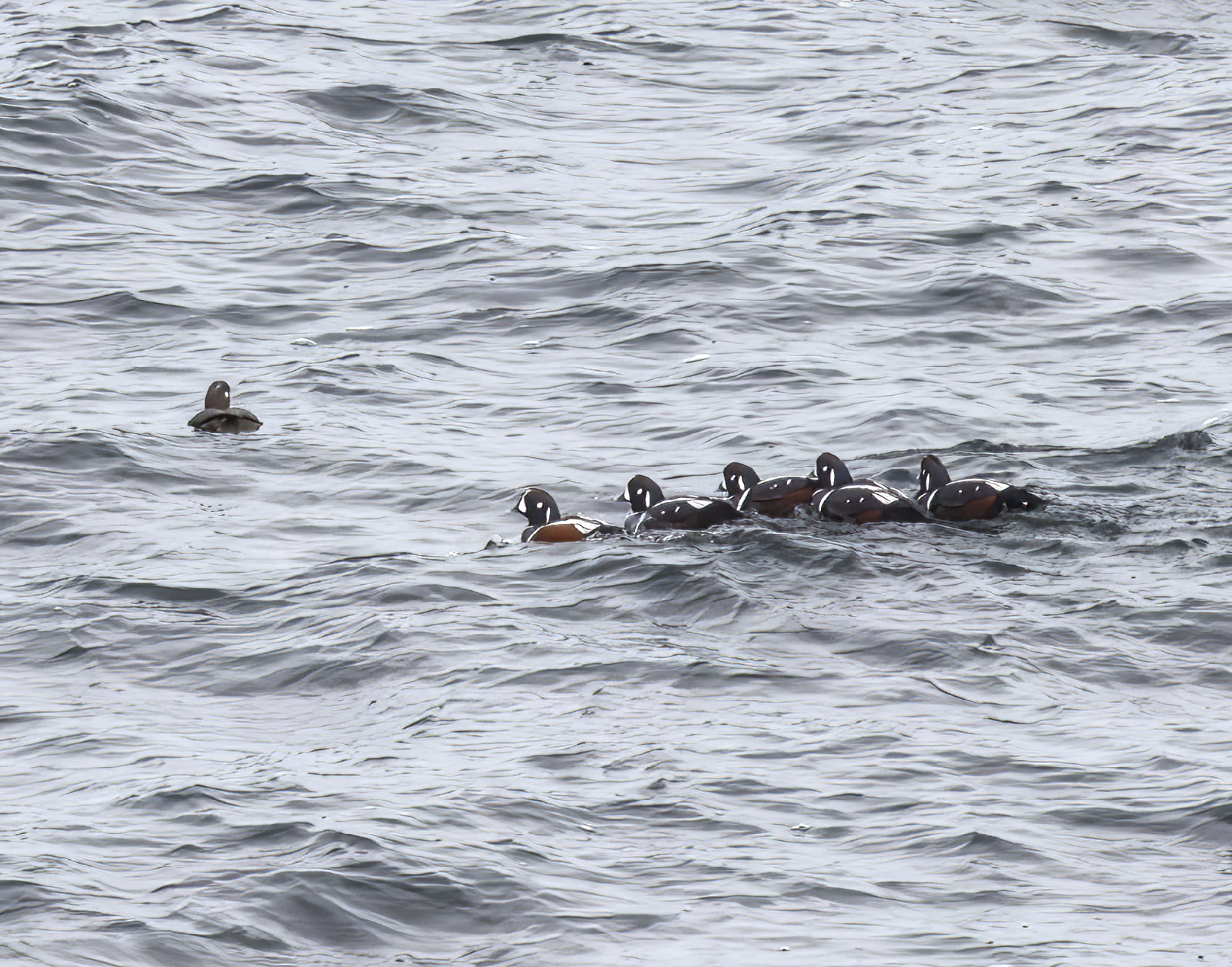
I didn't think the Atlantic was an ocean that should be overlooked, so I went to the overlook to overlook the ocean. I quickly discovered that there were more Harlequin Ducks than I think I've ever seen in one place at a time, counting at least 18 in this view:
I came home with over 100 images of them, such as this lineup of interested males:

And a closer approach:
 
 Followed by dispersal:
And a flyer: 
And also some Long-tailed Ducks, including one whose expression seemed quite imperious:


It was a fine day out. I'm glad I went.

13 September 2022

Update day! Whee!

Ubuntu's 22.04.1 LTS release came out fairly recently, and I had it on my to-do list to get around to updating some components of my personal digital empire once it did. I'd already been using 22.04 on my desktop for several months, to general satisfaction and particular appreciation of its having included a new enough version of Darktable to handle the CR3 raw format that one of my cameras produces.

So, to the updating. I have a DigitalOcean droplet that runs the Nextcloud snap. I like having a small bit of cloud that I can manage myself, primarily to share files among devices and sometimes with others. I use memory cards with higher storage capacity than the minimal droplet's 25GB, but it serves its purpose. sudo do-release-upgrade worked fine. One system checked off.

I also have a home server, which also hosts a Nextcloud alongside other services, for larger-capacity sharing within my LAN. Here, the Nextcloud instance hadn't auto-updated like the droplet's snap, and I (bad me!) hadn't been attentive to updating its versions while the service continued to "just work". After the OS upgrade, I found that the Nextcloud-in-place required a PHP version earlier than the 8.1 included with Ubuntu 22.04, so couldn't generate display pages. There's a third-party repository that has older PHP releases, but I wasn't quickly able to line up the right set of configuration for the old Nextcloud to make use of it, and it was Update Day anyway! After three successive updates to Nextcloud to successive versions, I got it current and able to find and use PHP 8.1. My screen sync icon winked with approval. 

Lesson: be aware of dependencies, and do upgrades when you have time to deal with surprises.  

02 January 2022

05 September 2021

Virtual Aviary

I set my virtual aviary site up a couple of years ago, but hadn't set up a pointer to it here until now. It started as a learning exercise in Python and Django, but I've kept it live and growing as a vehicle to host my collection of bird photographs. It's been satisfying and informative to structure and apply a database to organize the images based on metadata, and to explore tradeoffs between appearance and functionality. I'd never have gotten to its current count of 231 photographed species in New England without the help and company of other birders, so am appreciative for that. 

02 June 2021

Cryptic

Wikipedia describes the coloration of this Common Nighthawk as cryptic. I don't read this usage as relating to cryptography, or to a type of crossword puzzle, but it is certainly well camouflaged as it sleeps during a morning.


23 March 2021

Springtime!

Yes, I'm anthropomorphizing, but this White-breasted Nuthatch does seem suitably enthusiastic for the season!

13 February 2021

Iridescence in flat light

A bit of a science project here. I was out yesterday when I saw a Bufflehead swimming on a river. I enjoy these small ducks, which somehow look particularly playful as we see them in the winter. The males are noted for the iridescent colors in the plumage on their heads, as in this example from last year, but that's usually only noticeable when they're viewed in sunlight from the right angle.

My weather yesterday afternoon was cloudy. Flat lighting. Still, I enjoyed taking pictures of the Bufflehead. When I uploaded and processed them, I was surprised to see that colors were still present, as shown below. It's a noisier image and the lighting's clearly less appealing, but I still found it interesting to be able to see and distinguish the magenta, green, and blue areas around the bird's head.

 Nice to know that iridescent color isn't wholly extinguished in shadow!

22 January 2021

US Capitol flags for inauguration

When I watched this week's inauguration, I noted that there were five flags hanging from the US Capitol, but that only one was the current 50-star version. I wondered why, and was intrigued by the explanation I found at https://en.wikipedia.org/wiki/Betsy_Ross_flag. Apparently, every presidential inauguration displays Betsy Ross' 13-star flag, with its stars arranged in a circle, and there were two of these. There were also two copies of another 13-star flag, though. What were those about? It seems that each inauguration gets a flag of the version that was current when the incoming president's home state joined the union, and Delaware was one of the original 13 colonies. Barack Obama's inauguration, in contrast, featured a 21-star flag reflecting Illinois' later admission. I had not known that. 

24 December 2020

Details from the depths

After returning from a photo shooting session yesterday, I found that I had a sequence of a few shots in the middle that were drastically underexposed, though those before and after were fine. I believe that I inadvertently pressed the AE-Lock button for a few seconds, holding the exposure that would have been appropriate for reflected sun on a patch of water. The results manifested with auto-ISO sensitivity at the camera's minimum ISO setting of 100, while surrounding frames auto-set to ISO 400 or 500 along with a similar shutter speed and aperture. In any case, it's hard to identify the birds in this image as Black Scoters because, well, almost everything is black. 

Was there much data collected within the darkness, though? I opened the image in RawTherapee and applied 3 stops of exposure compensation, yielding the following:

 
Quite a bit more to see there. I'm impressed. There's some noise to be seen, and I certainly wouldn't make a intentional practice of underexposing by 3 stops, but it's nice to see that it's still possible to extract a decent image.

24 October 2020

Later fall colors

Nice stop here, enroute from vivid to barren. At least there'll be winterberry to see in the colder months. 


24 September 2020

Did I photograph the bird? Did I see it?

I was out on a (masked, size-limited, socially-distanced) birding trip yesterday, and the group was looking at gulls and other birds by the shore. There was discussion that a relative regional rarity, a Black-headed Gull, had recently been sighted there but no one spotted it before we left the site. Among other pictures, I took this shot with the Great Blue Heron in the foreground and Bonaparte's Gulls in the background.
Later in the day, I got home and uploaded the collected images from my camera. Hm. What was that unfamiliar bird that's flying in towards the top of the frame, with that unusual red beak? Let's look closer.

Field guides and online references suggested that this unexpected frame-crasher was in fact the Black-headed Gull that hadn't been seen in "real time" on the trip. (And, yes, its head wasn't Black as viewed, though it could have been if viewed in the different season and plumage for which it was named. Bird names are like that...) The group leaders, with far more years of birding expertise than I, agreed that it was. 

This raises an intriguing question of just what it means to see or photograph something. The Gull in question was clearly in the frame of the camera that I was holding and aiming when I pressed the shutter. I'll conclude that I did "photograph" it, at least in the sense of collecting its image. I don't recall being consciously aware of its presence, though. The first time I distinctly "saw" it was later in the day, when I viewed the digitized bits on a screen. I do appreciate its surprise visit, though!

Photo-geeky PS: as I think about the image more, I'm increasingly amazed by it. This was taken with a long lens with aperture almost wide-open, for about 900mm full-frame equivalent focal length. The larger version as shown was itself cropped to about half the width of the entire image as photographed. All these factors mean a lot of magnification, with not much depth of field. The autofocus locked on the heron in the foreground. Still, the Black-headed Gull is in sharper focus than the Bonaparte's Gulls in the background. So, not only did it decide to fly in at the right time to appear above the heron in my image, but did so at the relatively narrow distance range that would cause it to appear other than as a blur. How improbable?

07 September 2020

Notes on a personal software development cycle

I'm now taking and enjoying a MOOC that combines lectures and coding projects. I find these to be engaging learning experiences, providing good mental exercise. There's nothing like the sensation of "gee, I've now made this work". That said, I've watched myself do this many times, and observe some patterns. When approaching what appears to be a complex problem, I'll first tend to procrastinate, waiting for just "the right" combination of alert and undistracted time for concentration. Sometimes, I'll get to the point of first digesting the problem statement and contemplating its possible solution, and will then initiate another procrastination cycle. Eventually, I'll get into coding the project, and will become engrossed in populating the needed modules. I'll get to the point of a test run, and will try to deconstruct errors via inspection and by inserting debugging print statements. Sometimes, discussion forums will offer useful insight or pointers. I'll itch to complete the process. Finally, I'll (at least usually) get a set of working pieces together and obtain the desired result. It feels like a satisfying milestone, even as I'm aware that the MOOC authors have crafted the materials with the expectation that their students should be able to reach this point. I'll reflect on renewed appreciation of the fact that such resources are available. Thanks, 2020 Internet!

26 May 2020

Quarantining with history: Churchill and WWII

I've now finished a personal project that I stumbled into during COVID-19 quarantine. I looked at a bookshelf that was partly populated with volumes inherited from a late relative in the 1990s, and thought I'd pull out and try reading The Gathering Storm, whose ominous title turned out to be the first volume of Winston Churchill's six-volume history of World War II. I found it interesting, though perhaps more in terms of political and social aspects than military, and also found that I didn't have any of its successors. A few weeks later, thanks to Powell's Books, UPS, and a small order price, I had the whole set in hand.

Churchill presents the history with a personal and sometimes opinionated viewpoint, offering insight into developments as they occurred within top circles. He's not shy about criticizing decisions with which he disagrees, whether in the moment or by earlier UK governments. He can also be deprecatory of inconvenient factors active elsewhere, like Irish neutrality or the Indian independence movement, when they interfere with UK interests. Sometimes the narrative presents (perhaps for copyright or security reasons?) the intriguing challenge of inferring the content of a dialog based on the messages of only one participant. He cherished his Map Room, which could be a useful adjunct for a reader as well, as when trying to follow the progress of back-and-forth battle campaigns in North Africa.

Strategic planning across upcoming years proceeded alongside immediate tactical actions and reactions. Given the notably broad scope of power that Churchill wielded atop his coalition government, where he personally held multiple roles, it's notable and fortunate that he applied it in a well-considered manner. His confidence in eventual victory, despite desperate challenges, was impressive; perhaps his greatest pessimism was at the end, as Stalin's armies advanced across Eastern Europe laying the groundwork for Soviet satellites while defeating Germans. The collection's final volume, Triumph and Tragedy, so bears this stated Theme: "How the Great Democracies Triumphed, and so Were able to Resume the Follies Which Had so Nearly Cost Them Their Life".

Along the way, it seemed to me that lots of time and risk was devoted to conferences and associated travel, and that various critical decisions were deferred until in-person meetings could be arranged. Teleconferencing might have been useful if the technology were available and the principals were comfortable in using it. I'd known that Churchill had sought and anticipated US support in the war, and that his relationship with FDR was central in cultivating that support, but was interested to see it acknowledged that the attack on Pearl Harbor came as something of a relief by making US alignment against the Axis a certainty. I hadn't known, however, that the Allies formally termed themselves the United Nations from 1942 onwards. I also hadn't been familiar with some of the conflicts among the Allies, as with relative priorities for action in the Mediterranean vs. the English Channel and of regard for China. Even within the British Commonwealth, there was some tension with Australia and New Zealand, who were unsurprisingly concerned with their own security against Japan even as they sent armies to fight Germany in Europe. 

So, I was glad to be able to read and learn. It's a great thing that old books remain available and readable - no worries about conversion from obsolete data formats here! I proceeded through a few thousand pages, each printed before I was born. This was clearly a set that quite a number of people had bought in whole or in part back in its day, though perhaps sometimes one to be shelved and shown rather than actually read. I noted that one of my volumes had a number of uncut pages, but that another displayed an elegant bookplate. Overall, I found it good material to read at this point in time; the idea of positive and effective leadership in response to adversity seemed somehow encouraging and refreshing.

03 May 2020

I've been feeling rather like a Hermit lately, while mostly indoors

... and this Hermit (Thrush), symbolically enough, was the first species I found when out this morning doing some photography.


12 April 2020

Impending bird drama

I think there's some surprise impending shortly for the pair of Tree Swallows perched on the right, but am not enough of a bird to know exactly what will happen next. It was good to get outside today!